Sales are moving to the DMs
Stage by stage, word for word. This is where closing is going, and you're early.
Many of the people in your DMs would say yes right in the chat, if you knew how to take them there. And the rest don't get wasted: the ones who genuinely need a call get booked, and the quiet ones get a follow-up instead of getting forgotten. Every lead gets its best path.
This isn't only happening in your DMs. It's happening everywhere. Buying is moving out of calls and forms and into private messages, and every platform is racing to keep up. WhatsApp, Instagram, and Facebook built their businesses on it, and YouTube just reopened messaging on top. More attention, and more money, now changes hands in an inbox than at any point before.
And this isn't a feeling. In Gartner's latest buyer survey, 67% said they'd rather buy without talking to a sales rep for at least part of the purchase. Nearly a third of booked sales calls now end in a no-show. The buyer already left the call model. Most sellers just haven't noticed.
of buyers want to buy without ever talking to a sales rep
roughly 2 of every 3 people in your DMs
Source: Gartner buyer surveyWhy did they leave? Because they've been burned. After years of "free strategy calls" that turned out to be an hour of pressure, buyers learned to protect themselves: don't book, don't answer, don't get trapped. It isn't that people stopped buying. They stopped trusting the place where the pressure happens. A chat gives them room to think, re-read, and decide without anyone staring at them. That's why the yes moved to the inbox.
Which means the window is open, and it's about to get crowded. As the selling moves here, everyone is going to follow, and most of them will improvise their way through it.
The people who win this won't be the loudest or the most persistent. They'll be the ones running a process while everyone else guesses.
The closers with the close rates everyone envies aren't winning on the call. They're winning before it. Their DMs do the qualifying, the warming, and most of the convincing, so by the time anyone books, the decision is nearly made. That close rate everyone admires isn't a talent. It's what a conversation run properly looks like from the outside.
The second a lead gets interested, your instinct is to reach for a call. Because without one, you're afraid you can't get them to really open up, and you can't present your offer the way it deserves. The call feels like the only place real selling happens.
If closing in the DMs has never worked for you, it isn't because it doesn't work. It's because you were doing it without a process, and the call was quietly covering for everything that process was supposed to do.
That gap is costing you. You push toward a call, and the ready-to-buy ones cool off waiting for a slot. The ones who would never get on a call at all just disappear.
And be honest about one more thing. If a no-show has ever landed as relief instead of loss, you already know something's wrong with the model.
So why has nobody taught you to close where the buyers actually are? Look at what the industry sells: closing programs built for the call, setter trainings that teach you to use the DM to book the call, placements, booking software. Everything in that machine only makes money after a call gets booked. In that world the DM is only allowed to fill the calendar, never to finish the sale. Teaching you to take the payment right in the chat feeds none of it. So nobody taught it.
I call it the Call-Industrial Complex. The skill that finishes the sale in the chat has no industry pushing it, yet.

A call is one conversation at a time, in a row. The best closers alive run five or six in a day before they're spent, and the format itself caps it there, no matter how good you are. A DM conversation is parallel. You can keep twenty alive at once, all moving at the same time, none of them waiting on a calendar slot, and not one of them able to no-show.
That's two different ceilings. A call caps how many conversations you can run in a day. A DM doesn't. And that's before you count the people who would never have booked a call in the first place, the ones a call-only closer never even sees. The call was never the thing making you money. It was the ceiling on it.
Here's the simple version: your time is worth more than six calls a day. Your skill stays the same. If you use it on one conversation at a time, you have a job. If you use it on twenty conversations at once, the same hour of work does twenty times more. That's leverage.
(what one person can keep alive at once)
A DM that closes the sale, no call required, runs on eight stages, in order. Each one has a single job and the exact words to do it. Miss one, or run them out of order, and the conversation stops moving.
Every conversation shows you where the person actually is: ready to buy, needs one answer first, or gone quiet. Each one gets the right next step. You're never staring at a message wondering what to write, because every situation already has a stage and an exact line waiting.
“They replied, then went vague and quiet.”
Stage 2: Discovery
“They asked ‘how much?’ before they’re anywhere near ready.”
Stage 5: The Offer
“Let me think about it.”
Stage 6: Objections
“I can’t afford it right now.”
Stage 7: The Close
“The conversation went dead four days ago.”
Stage 8: Follow-Up
“They said yes, then went quiet before they actually paid.”
Stage 8: Follow-Up
Every one of these has a stage and a script in the Vault.
Offer owners, coaches, consultants, setters, closers, agencies, anyone whose income runs through conversations in an inbox. Directly or indirectly, if a DM is part of how you get paid, this is built for you.
It works because it sits at the level of the conversation, not the product. The way a person decides to buy in a DM is the same whether you're selling an info product, coaching, a service, or even e-commerce when the environment is right. You swap in what you sell, and the same eight stages run.
And it does it without a call. The stages still book one when a call genuinely makes sense, they work either way, but the whole point is you no longer have to. The yes happens in the chat.
And if English isn't your first language, or you simply think better in writing than on the spot, the chat works in your favor. You get time to think before you respond, and nobody hears an accent in a DM.
| Most DM training | The DM Close Vault |
|---|---|
| Tells you to “build rapport” and “handle the objection” | Hands you the exact words for every stage, ready to send |
| Frameworks from someone who studied selling | The actual sequence a real closer used on real money |
| Built to make your calls close better | Built to close in the chat, so you never need the call |
| “Here’s the idea, now go apply it” | Fill-in-the-blank, run it in your next conversation |
| Generic advice that works in theory | Runs on how people actually decide to buy in a DM |
| Teaches you to push harder | The calm conversations where the prospect talks themselves in |
If you love grinding out calls, your show-up rate is 100%, and nobody ever drops off because they couldn't find a time to talk, keep doing exactly what you're doing.
I built this because that wasn't true for me, and it isn't true for most people. I've taken over 3,000 Zoom and Google Meet calls in my sales career. I did so many that I started to hate them, because they were damaging the quality of my life. Back-to-back calls, ten hours a day, chained to a calendar that ran everything. I was earning good money, but I was so drained that I didn't have the energy left to properly show up for the woman I loved. And when a no-show came in, what I felt was relief.
Then I moved my selling into the DMs, and everything flipped. Selling finally fit my life instead of my life fitting the calendar. And I got good at it. Good enough to become the top DM closer on a ten-person team. No calendar owning my day, no back-to-back calls, zero no-shows, and the money still landed, right there in the chat. The exact words and system I used to do it is what's in the Vault.
And I'll be straight with you about one thing: the Vault itself is new. The process isn't — every stage and line in it is one I ran live in real conversations, not a framework I reverse-engineered after the fact — but buyer results are still being written. As the founding cohort puts it to work, their results get posted right here. Being early is the whole point.
Results not typical. Your success depends on your effort and offer.


Get the Vault. In your next few conversations, run the stages in order and use the words. When you hit an objection, use the script. When someone hesitates at the end, use the move.
Either you close more, or you don't, and you email me inside 30 days and I refund every cent. You keep the Vault, every script, and every bonus. I'm taking the risk here, not you.
Yes, because it works at the level of the conversation, not the product. "Too expensive" is "too expensive" whether you sell coaching, consulting, a course, or a service. "Let me think about it" is the same stall in every niche. The eight stages run on how people actually decide to buy in a DM, which doesn't change when the offer does. You fill in your offer and your voice, and the process handles the rest.
And if you're not sure your offer is shaped right for a text conversation, that's exactly what the DM Offer Playbook inside is for. An offer that lands on a call and one that lands in a DM aren't quite the same shape, and it shows you how to frame what you already sell so it converts in the chat.
The one thing it can't do is make people want something they fundamentally don't want. If that's the real problem, fix the offer first, and nothing should pretend otherwise. But if people want what you've got and you're losing them in the conversation, that's the part this fixes.
Yes. $27 once, and the Vault is yours. No subscription, no upsell required to make it work, nothing recurring.
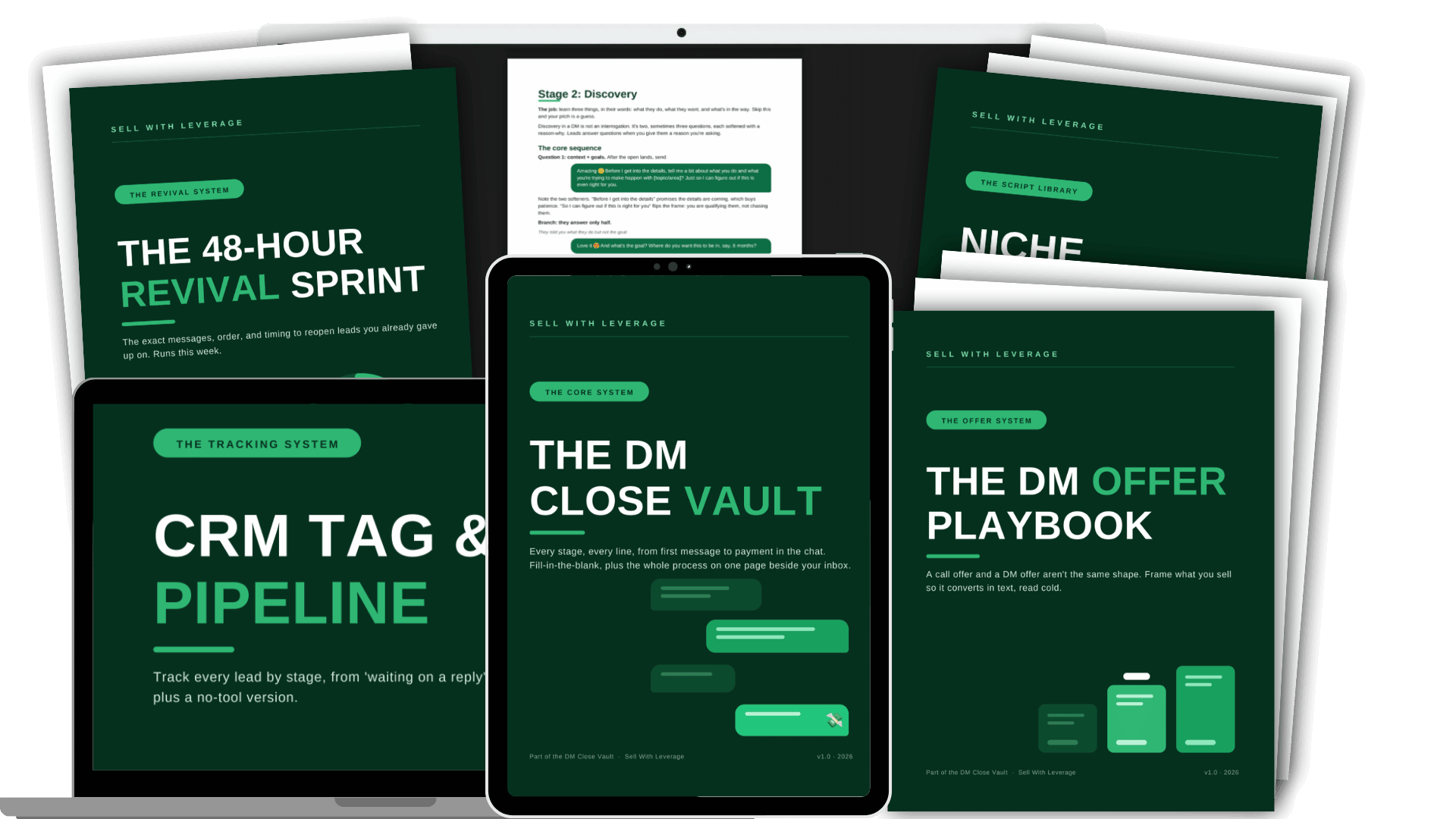
The full 8-Stage DM Close process with the exact words for every stage, plus five bonuses: the 48-Hour Revival Sprint, Niche Swipe Files, the CRM Tag & Pipeline, the Lead-Temperature Playbook, and the DM Offer Playbook. Instant digital download — total value $440.
Fill-in-the-blank. The structure and the lines are done; you swap in your offer and your voice. Most scripts are usable in your very next conversation, and the Niche Swipe Files give you versions already adapted for coaching, agencies, consulting, courses, and local services.
No. It runs in whatever inbox your conversations already happen in. The CRM Tag & Pipeline bonus ships with a ManyChat setup and a no-tool version that works in a plain spreadsheet, so you’re covered either way.
It works at the level of the conversation, not the product. The way a person decides to buy in a DM is the same across coaching, consulting, courses, and services. You fill in your offer, and if it needs reshaping for a text conversation, the DM Offer Playbook shows you how.
Yes. The stages still book a call when a call genuinely makes sense. The difference is you no longer have to: the qualifying, warming, and most of the convincing happen in the chat, so any call you do take is nearly closed before it starts.
Two reasons. It’s a founding price — the first 500 buyers get in at $27, then it goes to $47 and stays there. And $27 is low enough that there’s nothing to agonize over; you can just run it in your next conversation. The bet is simple: run it once, and you’ll want everything I build next.
Scrolled straight down? No problem. Here's exactly what $27 gets you.